
I saw this quote the other day:
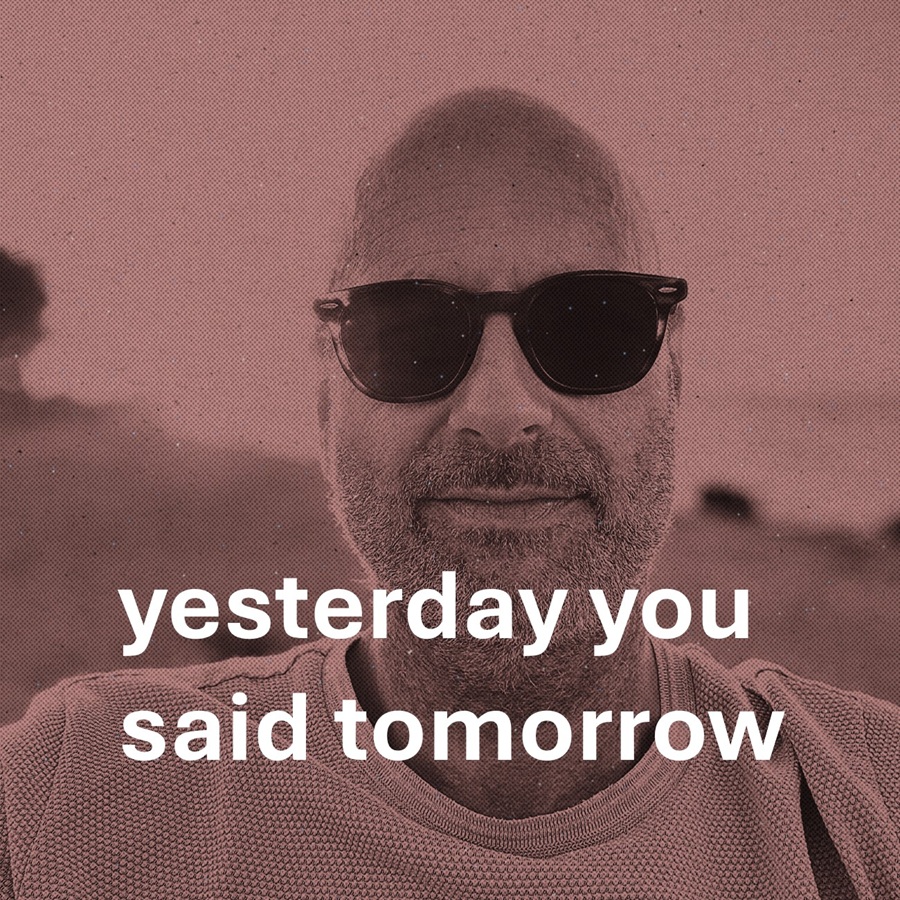
“Yesterday you said tomorrow.”
It stuck with me longer than I expected. Not because it’s profound. It’s actually pretty obvious.
But because it’s uncomfortably accurate.
The Pattern
I’ve said “tomorrow” a million times.
There’s always a reason, too. I’m too busy. Too much going on. I’ll get to it later. It’s cold. It’s dark. It’s raining. Too early. Too late. I’ll start fresh tomorrow when things feel more aligned. The reasons never stop.
On the surface, all of that sounds reasonable. Productive, even. Like I’m just managing priorities.
But I know my own bullshit.
Most of the time, “tomorrow” has nothing to do with timing. It’s just a lazy way to avoid doing something I already know I should be doing. No pressure, no consequences, no discomfort – at least not in the moment.
And that’s exactly why it’s so easy and works. Because it feels harmless. It feels temporary. Until I realized that tomorrow never actually shows up.
It just quietly turns into a pattern. And over time, that pattern becomes an ugly habit. A slow, comfortable slide into mediocracy, doing less than I know I’m capable of.
It’s a fucking trap.
Calling It Out
I’ve never really had a boss.
For the better part of three decades, there was no one holding me accountable. No one checking whether I showed up, did the work, or followed through. At most, I’d get the occasional side eye from Michelle – and even that was optional.
Which means everything was always on me.
And that cuts both ways.
In business, I always found the grit. I pushed hard. I showed up. I did what needed to be done. The stakes were clear, the feedback immediate, and the consequences were real.
But in other areas – my health, my fitness, the things that didn’t scream for attention – I let myself slide. Not all at once. Slowly. Quietly. One “tomorrow” at a time.
And because there was no external accountability, it was easy to get away with it.
Until it wasn’t.
After I sold my business, something changed.
The external pressure disappeared. No deadlines, no urgency, no one waiting on me. And suddenly, “tomorrow” didn’t feel like a good enough excuse anymore.
I couldn’t bullshit myself the way I used to.
At some point, you have to face the guy in the mirror – and he knows exactly what’s real and what isn’t.
No More Tomorrow
At some point, I stopped accepting “tomorrow” as an option.
Not because I suddenly became more disciplined, but because I started seeing it for what it really was – a convenient, lazy escape hatch. A way to delay something I already knew mattered.
So instead of negotiating with myself, I changed the environment.
I hired a personal trainer. It’s a lot harder to say “tomorrow” when someone is standing there waiting for you. That external commitment removes the option to quietly slide.
I built more structure into my days. Reminders. Checklists. To-do lists. Not because I’m forgetful, but because I know how easy it is to conveniently “forget” the things that require effort. It’s all part of my Life by Design approach – designing a life on purpose, with intent, reducing friction where it matters, and removing loopholes where I tend to exploit them.
And then there’s the part that matters most.
I’ve become very aware of how little time is actually left.
If I’m lucky, I have maybe twenty good years. Twenty summers. Twenty Christmases. Twenty birthdays.
That’s not a lot.
The Stoics had a phrase for this: memento mori — remember that you will die.
It sounds heavy, but it’s not. It’s clarifying.
Because once you really internalize that, “tomorrow” starts to lose its appeal.
Closing
I still catch myself saying it sometimes.
“Tomorrow.”
That reflex doesn’t just disappear. Old habits die hard. It’s been there for decades, and it still shows up in small, almost invisible ways. A skipped workout. A delayed decision. Something I know I should do, quietly pushed out of sight.
The difference now is that I notice it.
I don’t automatically believe it anymore. I don’t give it the same benefit of the doubt. Because more often than not, “tomorrow” isn’t a plan. It’s just a softer way of saying “not today.”
And I’ve seen where that leads.
A day turns into a week. A week into a pattern. A pattern into something that feels a lot like mediocrity – the kind that doesn’t arrive suddenly, but builds slowly, almost comfortably.
That’s the trap.
These days, I try to interrupt it early. Not perfectly, not every time, but often enough to change the trajectory. To do the thing when it matters, not when it feels convenient.
Because when you zoom out, there aren’t that many “tomorrows” left.
And that alone is usually enough to make today count a little more.